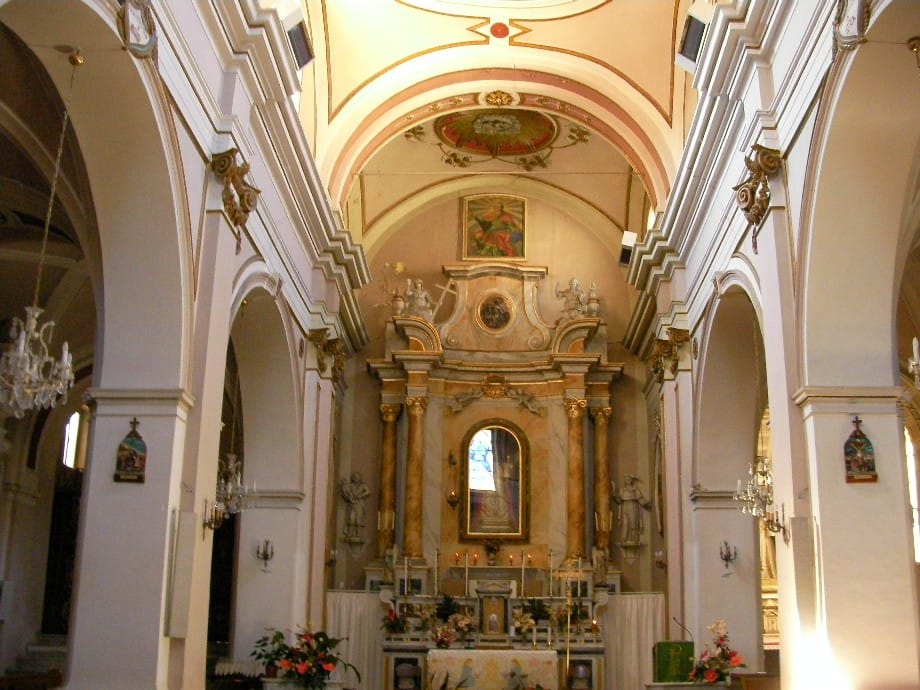
Between May 3 and the days that follow, a festival once thought to be lost returns to many towns in the province of Chieti: the Croci di Maggio, also known as the Feast of the Holy Cross. It is one of the oldest celebrations in the Abruzzo rural calendar, dedicated to the Invention of the Holy Cross—the discovery, according to Christian tradition, of the cross of Christ by Empress Saint Helena in the 4th century.
The crosses that can still be seen
Walking through the town’s districts—Le Morge, the hilly districts surrounding the historic center, along the ancient rural roads—one still encounters stone or iron crosses planted at intersections, at the edges of fields, and in front of old farmhouses. They are not gravestones: they are “stational crosses,” ritual markers that, in the rural parishes of Abruzzo, marked the territory and the points where the May 3rd procession stopped for a blessing.
They were both:
- Spiritual boundary—the line beyond which “another church begins,” another patron saint.
- Protection of the harvests — the May blessing, performed at the height of the wheat-growing season, was meant to ward off hail, drought, and pests.
- A resting point for farmers along rural roads.
The ritual: yesterday and today
In the rural towns of Abruzzo, the traditional festival included a procession led by the parish priest through the districts, with farmers decorating the cross in their area with branches of flowering broom, wildflowers, and colored ribbons. The rosary was recited, the wheat was blessed while standing, and a small offering—a candle, a bouquet, a handful of fava beans—was left at the foot of the cross.
In the postwar years, many crosses were moved; some were lost during urbanization, while others were restored. It is an ethno-anthropological heritage that various communities in Abruzzo are rediscovering thanks to the work of local tourist associations and neighborhood committees.
Why it’s worth it
- It is a quiet festival, far removed from major events. For those who want to understand the rural dimension of the town, this is the day to visit.
- The crosses are a map of rural archaeology: each cross tells the story of a neighborhood, a family that cared for it, a vow.
- It is linked to Marian May—the most “flower-filled” month of the Abruzzo folk calendar, encompassing the Feast of the Cross, Our Lady of Loreto, and Pentecost.
Sources and further reading
- Treccani — entries related to the May cycle
- Emiliano Giancristofaro, Tradizioni popolari d'Abruzzo, Newton & Compton, Rome, 1995 (chapter on May rituals).
- Abruzzo Region — fact sheets on ethno-anthropological heritage
- Archdiocese of Lanciano-Ortona, liturgical calendar of the parishes of the Sangro-Aventino region.
Voci della comunità
Sei il primo a lasciare un ricordo
Le storie del paese vivono nei dettagli che ognuno ricorda. Aneddoti, foto di famiglia, nomi dimenticati: tutto contribuisce a tenere viva la memoria.

Lascia il tuo ricordo