
On the hill above the Sangro River, in a spot overlooking the sea and the lower valley, lies a crucial chapter of World War II. It is the Sangro River War Cemetery: the largest Commonwealth war cemetery in Italy, with 2,617 official burials.
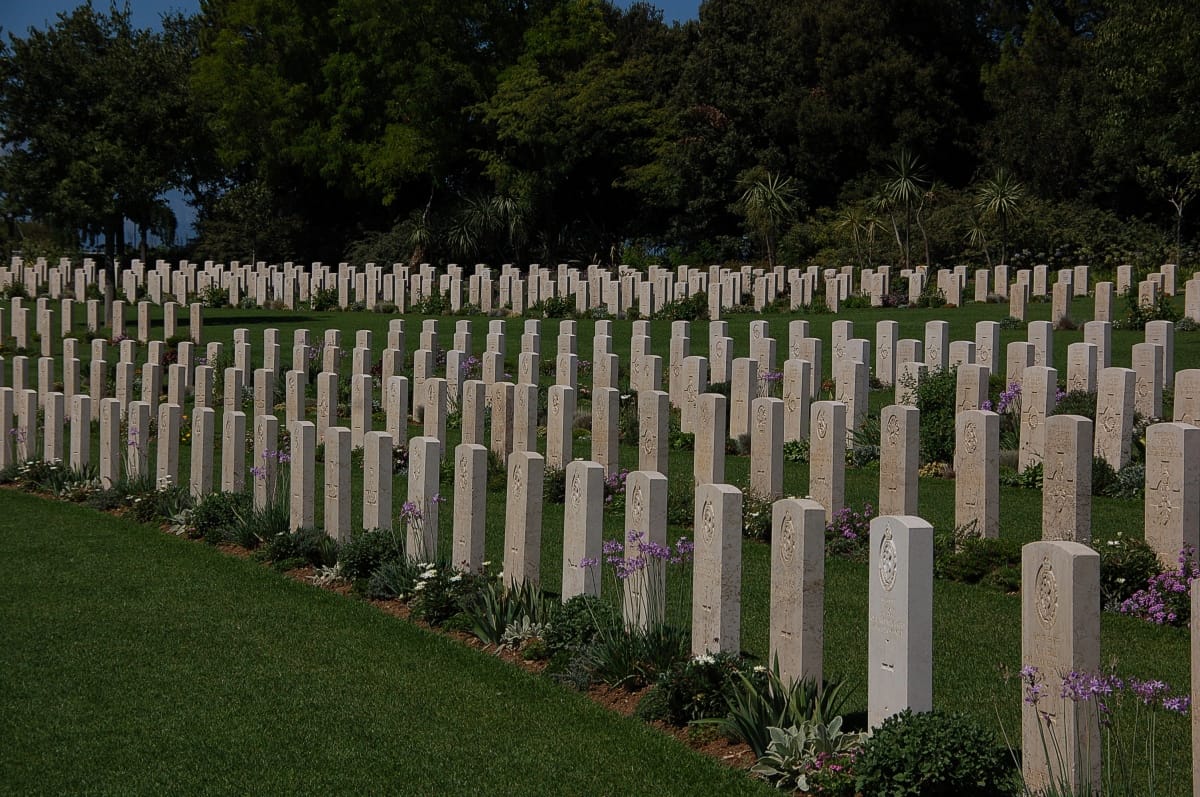
Buried here are British, Canadian, Indian, New Zealand, South African, and other Commonwealth soldiers who fell between November 1943 and the early months of 1944 during the Battle of the Sangro—one of the fiercest engagements of the Italian Campaign.
What Was the Battle of the Sangro?
To understand why this cemetery exists, we must go back to the fall of 1943. Following the Allied landing in Sicily (July 1943) and the signing of the Italian armistice (September 8, 1943), the Allies advanced up the peninsula from south to north, seeking to liberate Italy from German troops.
The Germans, under the command of Field Marshal Albert Kesselring, had built a series of transverse defensive lines—the most famous being the Gustav Line, which stretched across the peninsula from Gaeta on the Tyrrhenian Sea to Ortona on the Adriatic, running along the Sangro River.
The British Eighth Army, under the command of General Bernard Montgomery, received orders to break through the Gustav Line in its Adriatic sector. The main attack was launched on the night of November 27–28, 1943, crossing the Sangro River precisely at the section near Torino di Sangro.
The Conditions of the Battle
The battle lasted over three weeks. Conditions were prohibitive:
- Constant rain — the river, normally fordable, swelled to three times its normal flow.
- Mud—Allied armored vehicles got bogged down. Many Sherman tanks had to be abandoned.
- An excellent defensive position for the Germans—on the hills behind the river, with artillery in position.
- Winter cold — British, Indian, and New Zealand soldiers, accustomed to different climates, suffered greatly.
“Those soldiers weren’t used to Italian mud. They called it ‘Italian mud,’ and in their letters home they described it as an enemy stronger than the Germans.”
Allied losses were heavy: an estimated 3,000 or more were killed or missing in action in the direct fighting in the Sangro sector, with an equal number wounded. But the line was breached. The advance northward resumed and culminated on December 28, 1943, with the liberation of Ortona after a horrific urban battle, dubbed the “Stalingrad of Italy.”

The cemetery: what it looks like
The Sangro River War Cemetery is managed by the Commonwealth War Graves Commission (CWGC), the international organization founded in 1917 to maintain Commonwealth military gravesites worldwide. The maintenance is impeccable and identical for every CWGC cemetery, from Ypres to El Alamein:
- Neat rows of white Portland stone headstones, uniform in shape and size regardless of rank.
- Cross of Sacrifice — a large stone cross at the center of the cemetery, found in all CWGC cemeteries with more than 40 graves.
- Memorial Stone — a rectangular block engraved with the phrase “Their Name Liveth For Evermore” (Ecclesiastes 44:14), designed by architect Edwin Lutyens.
- Impeccable lawns and flower borders — maintained weekly year-round.
On every headstone: name, rank, regiment, date of death, age, religious symbol, and—where the family requested it at the time—a personal inscription of a few words. These are the most poignant inscriptions: “Beloved son of…,” “He died that we might live,” “Always in our hearts.”
Visitors from the Commonwealth
About 6,000 visitors arrive each year, the vast majority of whom are Canadian and British. They are often descendants of soldiers buried here: children, grandchildren, great-grandchildren, who come for the first time to see the headstone of a father or grandfather they never knew.
On Remembrance Sunday (the second Sunday in November, the British anniversary of the Great War) and November 11 (Remembrance Day), the cemetery is the site of official ceremonies attended by diplomatic officials from the United Kingdom, Canada, and India.
Visiting
- Address: Mozzagrogna-Ponte Sangro, about 4 km from the center of Torino di Sangro.
- Hours: Open year-round, from sunrise to sunset. Free admission.
- Accessibility: The main plaza and avenues are wheelchair accessible.
- Facilities: parking, guestbook, mailbox for messages to families. No cafes or commercial services—this is a place of silence.
- What to bring: respect. It is a cemetery. No picnics, no music, no close-up photographs of the headstones for recreational purposes.
From the plaza, you can enjoy an exceptional view of the lower Sangro Valley and the Adriatic Sea. It is paradoxical today to think that right here—under this sky, in this light—such violent fighting took place eighty years ago.
Sources and further reading
- CWGC — official entry for Sangro River War Cemetery
- Battle of the Sangro — Wikipedia (with academic sources)
- G. A. Shepperd, The Italian Campaign 1943-45, Arthur Barker Ltd, London, 1968.
- Mark Zuehlke, The Liri Valley: Canada’s World War II Breakthrough to Rome, Douglas & McIntyre, 2001.
- Historical Archives of the 78th Battalion (Canadian Infantry) — field diaries, December 1943.
Voci della comunità
Sei il primo a lasciare un ricordo
Le storie del paese vivono nei dettagli che ognuno ricorda. Aneddoti, foto di famiglia, nomi dimenticati: tutto contribuisce a tenere viva la memoria.


Lascia il tuo ricordo