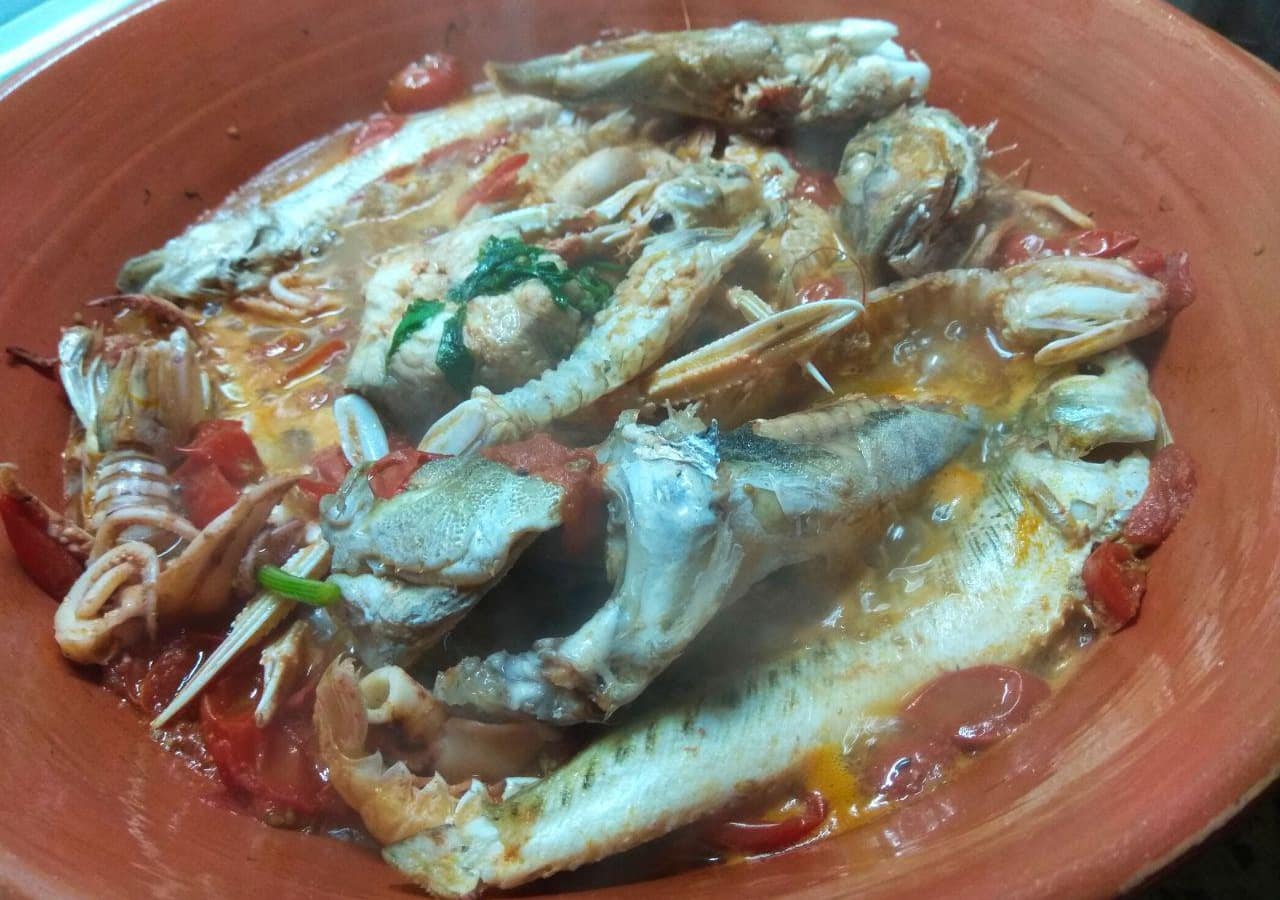
All along the Adriatic coast, from Veneto to Puglia, every port has its own fish soup. It goes by different names—brodetto, brudet, boreto, ciuppin—but the concept is always the same: cooking together, in a single pot, the small, low-value fish that were left at the bottom of the baskets at the end of the day. On the Trabocchi Coast, the local version is simply “il brodetto”: humble seafood cuisine, perfected over time, now the signature dish of trabocchi restaurants and coastal trattorias.

Why is it called "brodetto"?
The name is a diminutive: “little broth.” It was the soup fishermen made on board at the end of their catch, using fish that couldn’t be sold—too small, too ugly, or battered by the net. Olive oil, chili pepper, a few ripe tomatoes, seawater for salt, and dry bread to thicken it. They ate it on deck, in wooden bowls, before returning to port. The same logic applied on the trabocchi: fish caught just a few hours earlier, cooked on the wooden platform with whatever was on hand.
From a dish made from leftovers, it became, as early as the early 20th century, a harbor tavern staple, and eventually a traditional recipe.
The family of Adriatic brodetti
Brodetto is not a single dish; it is a family of dishes. Along the central Adriatic coast, at least four distinct versions can be identified:
- Brodetto fanese (Marche) — with vinegar, tomato, and at least nine types of fish.
- Brodetto di San Benedetto del Tronto (Marche) — without tomato, with green chili pepper.
- Brodetto di Porto Recanati — the “white brodetto,” with zafferanella.
- Brodetto vastese (Abruzzo) — codified by the Confraternita del Brodetto Vastese in 1987 in Vasto, with sweet peppers and fresh tomatoes.
For Torino di Sangro and the municipalities of the Costa dei Trabocchi, the closest reference is the Vasto version: same coastal fishing, same basic ingredients, same “pan-to-table” approach. It would not be correct to strictly call the Turin-style fish soup “Vastese”—the Vasto specification is territorial and protects a precise recipe, codified in that city—but the family recipes made in Le Morge, on the trabocchi, and in the restaurants of the Lido belong to the same southern Adriatic school.
“You can tell a good brodetto by how you eat the bread: it should soak up the soup, not just sit on the plate.” — an old saying among the coastal fishermen.
What makes a “Trabocchi Coast” brodetto
The common characteristics of the brodetti eaten between Ortona and Vasto, including Torino di Sangro:
- No vinegar — unlike the versions from the Marche region, here the soup is “mild,” without any acidity.
- Sweet pepper — not spicy, but ground dried sweet pepper, a signature Abruzzo spice. It gives the soup its unmistakable red-orange color.
- Fresh tomatoes cut into large chunks, never tomato paste.
- Terracotta pot — the soup is cooked and served in the same pot, without being transferred.
- Toasted local bread — usually bread from Castel di Sangro or homemade local bread.
The fish
Traditional recipes (primarily from Vasto) call for at least nine different species of local fish. On the trabocchi and in Turin trattorias, you’ll typically find:
- Rock mullet
- Redfish
- Turbot
- Stingray
- John Dory (when available)
- Prawns and scampi
- Squid, cuttlefish
- Mussels and clams
- Mantis shrimp
The idea is simple: the more species there are, the more flavors blend together. That was the rule of net fishing and the trabocco: you caught whatever came along, and you cooked with that.
The quick recipe (family version)
No strict rules—this is the version made in homes along the Sangro River:
- In a large earthenware pot, sauté garlic and parsley in extra-virgin olive oil from Abruzzo.
- Add the ground sweet pepper (one level tablespoon) and the fresh chopped tomatoes.
- Layer the fish, from the firmest to the most delicate: first the shellfish, then the firm-fleshed fish, and finally the delicate fish and crustaceans.
- No water, no wine: the fish releases its own liquid, and that is enough.
- Cover, low heat, 18–22 minutes. Never stir: just shake the pot.
- Serve in the same pot, with toasted homemade bread.
Where to eat it in Torino di Sangro
- The trabocchi-restaurants along the Turin coast offer it as the “daily special,” featuring the morning’s catch.
- The trattorias in Lido and Le Morge stick to the family recipe.
- The Pro Loco’s summer festivals—especially in July—often include a “brodetto” evening.
It costs between 25 and 35 euros per person, depending on the quality of the catch of the day. It’s a dish you need to order in advance: it’s made in a single pot for four to six people, not just one.
And if you want to really understand the difference
Vasto is less than half an hour from the center of Torino di Sangro. Those who want to taste the brodetto in its “traditional” version—the one codified and protected by the Confraternita del Brodetto Vastese—can do so in the restaurants of Vasto’s historic center or along the Vasto Marina waterfront, and then compare it with the “Trabocchi Coast” version served on the trabocchi of Torino di Sangro. Same family, same basic flavors, but slight differences in the proportions, the fish, and the bread.
Sources and Further Reading
- Confraternita del Brodetto Vastese — regulations and history of the codified version
- Walter Filiputti, I brodetti dell'Adriatico, Slow Food Editore, Bra, 2012.
- Slow Food — profiles on Adriatic brodetti
- Pasquale Verlengia, History of Fishing in Abruzzo, Edizioni Meridiana, Lanciano, 1972.
Voci della comunità
Sei il primo a lasciare un ricordo
Le storie del paese vivono nei dettagli che ognuno ricorda. Aneddoti, foto di famiglia, nomi dimenticati: tutto contribuisce a tenere viva la memoria.


Lascia il tuo ricordo