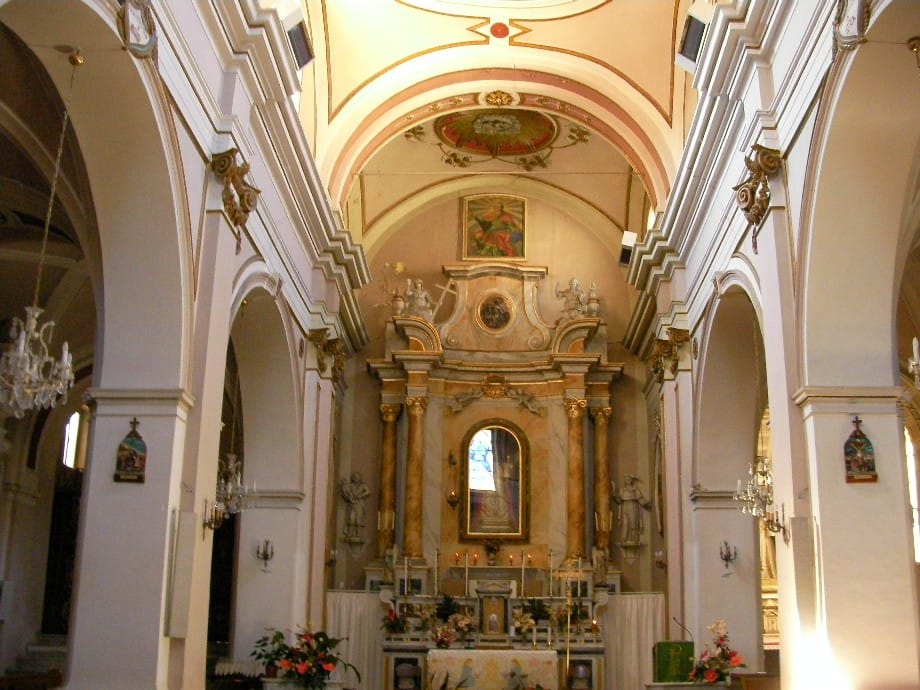
Holy Week is the heart of the Catholic liturgical year—the seven days from Palm Sunday to Easter. In Abruzzo, and in Torino di Sangro, it is also the time when the religious dimension becomes most visible: evening processions through the town’s streets, brotherhoods in traditional ceremonial robes, and a dramatic liturgy steeped in ancient symbols.

The Days of the Triduum
There are three key days—the Easter Triduum—plus Palm Sunday (the symbolic entry) and Easter Sunday (the conclusion).
Palm Sunday
Olive branches are blessed in the square in front of the Mother Church. Families take them home: they will be used to decorate doors and fields, and the following year they will be burned to produce the ashes for Ash Wednesday. It is a ritual chain that links one year to the next.
Holy Thursday
In the evening, during the “Missa in Coena Domini,” the Last Supper is commemorated. Immediately afterward, the “Sepulcher” (correctly: Altar of Reposition) is set up in the church—a side altar adorned with wheat sprouted in the dark during the preceding weeks, white flowers, and candles. It is traditional, after Mass, to make the “tour of the sepulchres”: visiting, in silence and in succession, the altars of nearby churches. In Torino di Sangro, this practice takes place in the Mother Church.
Good Friday
The most dramatic day. No Mass—it is the only day of the liturgical year on which Mass is not celebrated. In the afternoon, the Liturgical Action of the Passion; in the evening, the procession of the Dead Christ.
“On Good Friday evening, the town walks to the beat of the drum. No one speaks. It is the only procession in which even the children remain silent.”
Holy Saturday
A day of silence. In the evening, the Easter Vigil: the fire, the Paschal candle, the renewal of baptismal vows. Midnight: bells ringing out, it is Easter.
The Procession of the Dead Christ
It is the most dramatic moment of the week. A slow, evening procession, accompanied by the slow beat of the drum and the “Lamentations” sung by the brotherhoods. Two wooden statues are carried, often from the Neapolitan school of the 18th or 19th century:
- The Dead Christ — lying on a wooden coffin draped in black.
- Our Lady of Sorrows — dressed in black, her heart pierced by seven swords.
The statues are carried on the shoulders of the brotherhood members along a set route—the Mother Church, the streets of the historic center, and the churchyard. The town’s windows are dark; some hold a candle. The rosary is recited, and the Latin verses of the Stabat Mater are sung.
The Confraternities
The confraternities are lay associations that, since the Middle Ages, have managed the most solemn rites of the parishes. In Torino di Sangro, as in other towns along the Sangro River, the Confraternity of the Most Holy Sacrament (generally wearing white robes with a red mozzetta) and that of the Suffrage or of the Carmine (wearing darker robes) have historically been active. Members wear the traditional garb: tunic, cincture, and hood (the “buffa”). It is an ancient community tradition, and many confraternities today recruit new members from among the young to keep the tradition alive.
The Flavors of Easter
The cuisine of Holy Week is specific:
- Friday — strict fasting: simple fish, salt cod, "salty ferratelle" with cheese.
- Saturday evening, after the Vigil—finally meat. Salami, capocollo, blessed hard-boiled eggs.
- Easter — roast lamb with potatoes, fiadoni (savory ravioli stuffed with cheese), sweet Easter pizza, “pupe” (sweet breads shaped like dolls, given to children).
- Easter Monday — outdoor lunch in the countryside, with egg and chicory frittata, cold lamb, and wine.
Sources and further reading
- Diocese of Chieti-Vasto — liturgical calendar and information sheets on the confraternities.
- Emiliano Giancristofaro, Holy Week in Abruzzo, Carsa Edizioni, Pescara, 2003.
- Confederation of Confraternities of the Dioceses of Italy
- Italian Episcopal Conference — liturgical notes for the Easter Triduum.
Voci della comunità
Sei il primo a lasciare un ricordo
Le storie del paese vivono nei dettagli che ognuno ricorda. Aneddoti, foto di famiglia, nomi dimenticati: tutto contribuisce a tenere viva la memoria.

Lascia il tuo ricordo