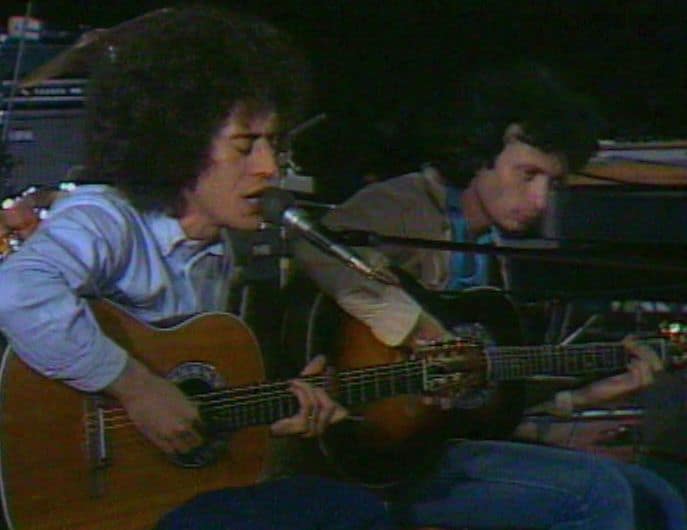
He was born in Milan on March 16, 1952, but his roots are in Torino di Sangro: his father is from that town, and the family continued to visit it throughout his childhood. It is one of those stories of dual identity that run through 20th-century Italy—people from the South who migrated to the North for education or work, yet never completely severed their ties to their homeland.
Maurizio Fabrizio entered the Giuseppe Verdi Conservatory in Milan at the age of eleven. He studied piano, composition, percussion, bassoon, and double bass. He taught himself to play drums and guitar. He is the portrait of a complete musician, capable of conceiving a piece in all its parts simultaneously—the quality that would launch his career as a composer.
La Scala, at 17
In 1969, while still a student at the Conservatory, he was hired as a percussionist in the orchestra of La Scala, under the direction of Claudio Abbado. It is a detail that music enthusiasts note: the same orchestra, the same conductor as Donato Renzetti—another Abruzzese from Torino di Sangro, who had arrived at La Scala’s timpani section shortly before. Two boys from the same town, in the same orchestra, in the same year. It was no coincidence: the musical training in Torino di Sangro was rigorous.
The Pop Breakthrough and Branduardi
In 1970, Maurizio formed the duo “Maurizio e Fabrizio” with his brother Popi, releasing several singles and reaching the Sanremo Festival in 1971. From there, his brother changed course, and Maurizio focused on composing for other artists.
It was during that period that he met Angelo Branduardi. For him, he would write some of the most recognizable melodies of the Italian 1970s—including “La pulce d’acqua,” the Lombard singer-songwriter’s iconic song. That collaboration opened the door to all the others.
Sanremo: The Record
From 1971 to the present, Maurizio Fabrizio has brought 37 songs to the Sanremo Festival. He is the most prolific composer in the Festival’s history. The tally:
- Two first-place finishes
- 1982 — “Storie di tutti i giorni,” performed by Riccardo Fogli. It became one of the defining songs of the Italian 1980s
- 1983 — "Sarà quel che sarà," performed by Tiziana Rivale
- Three third-place finishes
- Dozens of songs that made it into the Festival’s top ten over a 40-year career
Two consecutive victories in 1982–1983 are a feat even the most established composers would struggle to match.
The artists for whom he has written
The list of performers who have sung Maurizio Fabrizio’s music is a sort of map of Italian song spanning half a century:
- Mia Martini — for her he wrote (with lyrics by Bruno Lauzi) "Almeno tu nell'universo," one of the most beloved Italian songs of all time
- Mina
- Ornella Vanoni
- Patty Pravo
- Mietta — "Vattene amore" (Sanremo, third place)
- Al Bano
- Riccardo Fogli — a historic collaboration that began in 1979 with "Che ne sai" and "Malinconia," culminating in victory at Sanremo 1982
- Eros Ramazzotti
- Antonello Venditti
- Renato Zero
- Angelo Branduardi
- Miguel Bosé
- Iva Zanicchi, Anna Oxa, Giorgia, Donatella Rettore, Eduardo De Crescenzo, Rossana Casale, Alexia, Toquinho
Try turning on an Italian radio station—any one, on any given day. The odds that a song by Maurizio Fabrizio will play within an hour are extremely high. Most listeners don’t even know his name. “That’s the beauty of our profession: songwriters always stay behind the scenes. The singers are up front, and that’s how it should be.”
Awards
- Most prolific composer in the history of the Sanremo Festival: 37 songs
- Winner of the Sanremo Festival in 1982 (with Riccardo Fogli) and 1983 (with Tiziana Rivale)
- SIAE plaque for the volume of royalties generated by his songs — among the most commercially successful Italian composers of the 1980s and 1990s
- Numerous appearances as a conductor at the Sanremo Festival
- Co-author of some of the best-selling Italian pop albums of the late 20th century
Also a singer-songwriter
In recent years, Fabrizio has resumed singing on his own, releasing albums where he reinterprets his most famous hits written for others. “Tutte le direzioni” is one of the latest chapters—Il Resto del Carlino also mentioned it in a review: “Almeno tu nell’universo” resonates once more.
The connection to his hometown
Maurizio Fabrizio returns to Torino di Sangro for family visits. When the town hall or the Pro Loco organizes major cultural events, his name is one of those mentioned with pride. He has collaborated on initiatives to promote Abruzzese music and, in more than one interview, has acknowledged that his first ear for melody came from his father’s hometown band and the songs of the patron saint festivals.
Sources
- Wikipedia (en) · Maurizio Fabrizio
- mauriziofabrizio.com · Official biography (PDF)
- Rockol · Artist profile
- Aria di Musica · Biographical profile (PDF)
- Paolo Pontivi · Interview with Maurizio Fabrizio
- Il Resto del Carlino · "Fabrizio Conquers All Directions"
- EuropAmici · Branduardi-Fabrizio Discography
Voci della comunità
Sei il primo a lasciare un ricordo
Le storie del paese vivono nei dettagli che ognuno ricorda. Aneddoti, foto di famiglia, nomi dimenticati: tutto contribuisce a tenere viva la memoria.

Lascia il tuo ricordo