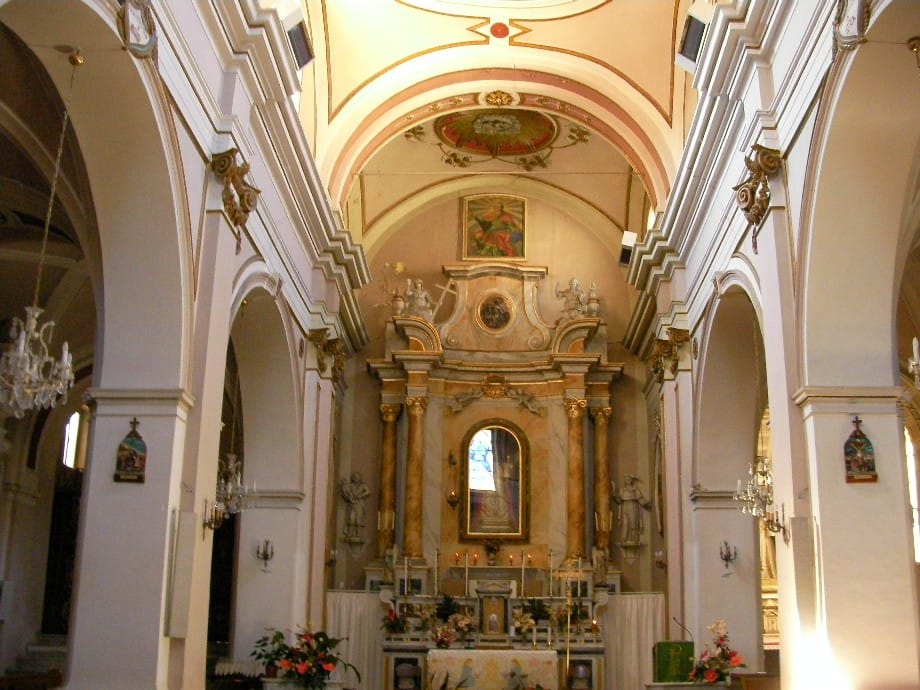
Every town has a tradition that defines it. In Torino di Sangro, it is the Visadorno (in the local dialect, Vis Adorne = “adorned face”): an ancient folk song that, in the early hours of December 10—the feast day of Our Lady of Loreto—accompanies the entire town in a devotional procession that is unique in the Abruzzo region.

What happens
On the evening of December 9, the statue of the Madonna is finely adorned: robes, a cloak, and votive jewelry donated by families over the decades. At the first light of dawn on the 10th, while the town is still shrouded in an almost unreal silence, the statue is carried to the churchyard of the Mother Church.
There, on the stone steps, a waiting crowd gathers. The town band begins to play softly, and from the square rises the song “Buongiorno alla Vergine”: a polyphonic chorus passed down from generation to generation, for which no official score exists. It is learned as children, listening to their grandparents. This is followed by a moving “Pastorale”—a Christmas melody in a folk style.
“What takes your breath away isn’t the singing. It’s the silence before the singing. Hundreds of people, in the cold, in the dark, waiting for a sound that exists only here, once a year.”
The Town Tour
After the ceremony in the square, the musical morning continues through the town streets. The group of singers—all men, all from the town—moves from house to house, stopping first at the mayor’s, then at the parish priest’s, then at the other local authorities’, and finally at the homes of friends and the town elders.
At every door, they sing personalized verses: lines composed for that specific family, naming the children, remembering the deceased, wishing for a good harvest and fair winds. It is an act of collective memory: the singing affirms that the community exists and recognizes itself in its own names.
The doors open. Blessed taralli and hot coffee are exchanged. Smiles. Tears, sometimes, from those who have lost someone and hear their surname sung for the first time since their loss. The round lasts all morning; sometimes it extends until noon.
Origin of the ritual
Documented accounts of the Visadorno date back to the early 19th century, but local historians agree on a 17th-century origin: it likely began as a popular vow following a plague epidemic that the town attributed to the intercession of the Madonna of Loreto.
The name Vis Adorne (“adorned face”) refers to the decorated statue: in the most common version, the Madonna is dressed like a bride, with a veil, jewelry, and an embroidered cloak—a representation that blends the sacred and the popular in a typically southern style.
In 2019, the Abruzzo Region recognized it as a “ritual to be protected” in its list of intangible cultural heritage, alongside the New Year’s Maitunate and other coastal singing traditions.
For those who wish to participate
- When: dawn on December 10. Arrive at the churchyard of the Madonna di Loreto by 6:30 a.m.
- Dress: Warmly. December in the Abruzzo hills can be below freezing.
- Etiquette: silence before the singing begins. No flash photography, no video recording with audio during the Pastorale: it is an intimate moment for the community.
- Afterward: the day continues with a solemn Mass (10:00 a.m.) and a community lunch organized by the Pro Loco.
Sources and further information
- Abruzzo Region Tourism — Torino di Sangro and the Viso Adorno ritual
- Zonalocale — "The Good Morning of the Visadorno" (2019)
- VastoWeb — December 10 Festival dedicated to Our Lady of Loreto (2025)
- Vincenzo Balzano, Historical Memoirs of Torino di Sangro, Lanciano, 1922 (chapter on Marian festivals).
Voci della comunità
Sei il primo a lasciare un ricordo
Le storie del paese vivono nei dettagli che ognuno ricorda. Aneddoti, foto di famiglia, nomi dimenticati: tutto contribuisce a tenere viva la memoria.


Lascia il tuo ricordo